
Now Reading: Coronavirus: Deaths will pass 50,000 in ‘the next few days’, WHO says
-
01
Coronavirus: Deaths will pass 50,000 in ‘the next few days’, WHO says


The organisation’s director-general Dr Tedros Adhanom Ghebreyesus told reporters on Wednesday evening that the growing number of COVID-19 deaths was “deeply concerning”.
He said: “As we enter the fourth month since the start of the pandemic, I’m deeply concerned about the rapid escalation and global spread of infection.
“Over the past five weeks we have witnessed a near exponential growth in the number of new cases reaching almost every country, territory, and area.
“The number of cases has more than doubled in the past week. In the next few days, we will reach one million confirmed cases and 50,000 deaths.”
His words came as the number of confirmed cases worldwide sat at around 911,000 and the number of deaths more than 45,000.
While China, where the virus originated, initially had by far the most cases, it has now been overtaken by the US (203,000), Italy (110,000) and Spain (102,000). Germany, France, Iran and the UK are closing in behind.
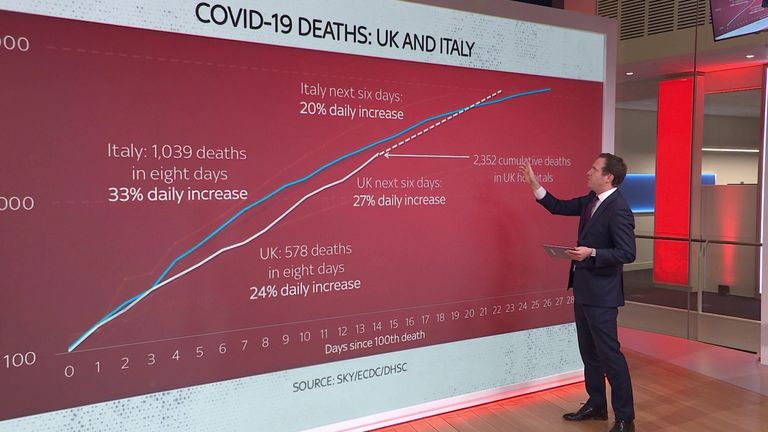
Ed Conway looks at how the UK’s death rate compares to Italy’s
On Wednesday the Department of Health said 29,474 people had tested positive for coronavirus in the UK, 4,324 more than the 24 hours before.
563 people were confirmed to have died after testing positive for the disease – bringing the total number of deaths to 2,352.
Dr Tedros called for more help to be directed at developing countries, including those in Africa and Central and South America, where he said COVID-19 “could have serious social, economic, and political consequences”.
He said it was “critical” that those countries were well equipped to detect, test and isolate cases, as well as identifying contacts of those confirmed to have been infected.
“Many countries are asking people to stay at home and are shutting down population movement, which can help limiting transmission of the virus but can have unintended consequences on poor and vulnerable people,” he added.
But he did offer some hope, saying that the organisation – thanks to worldwide co-operation – was learning more about the disease every day.
He said: “Three months ago we knew almost nothing about this virus but collectively we have learned an enormous amount and every day we learn more.”
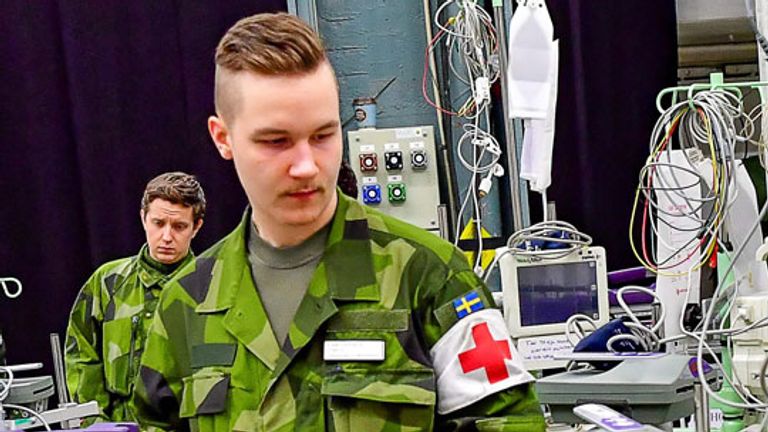
Why hasn’t Sweden gone into lockdown?
He said there had been an “extraordinary response” to the WHO’s call for countries to join trials aimed at finding cures and vaccines against the disease.
Some 74 countries have joined the trials so far – or are in the process of joining – with more than 200 patients so far being assigned to one of the “study arms”.
Dr Tedros added: “Each patient who joins the trial gets us one step closer to knowing which drugs work.”